
Roundup and the Cancer Debate: Glyphosate, Lawsuits, and the Hidden Cost of Industrial Agriculture
Commentary by Rob
Original Article: https://www.pbs.org/newshour/nation/supreme-court-will-hear-appeal-by-maker-of-roundup-weedkiller-to-block-thousands-of-lawsuits
Bayer has paid out nearly $11 billion to settle lawsuits centered on Roundup, the weed killer, all while the world can’t make up its mind about whether or not glyphosate, the active ingredient in Roundup, causes cancer. The EPA has deemed that it is “not likely to be carcinogenic”[1] while the World Health Organization’s (WHO) International Agency for Research on Cancer (IARC) has said it is "probably carcinogenic to humans.”[2] Currently, Bayer is seeking to block state lawsuits in the US—using as a defense the EPA’s decision that allowed their product to be sold without a cancer warning.[3] Once again, organizations, the law, and public awareness necessarily lag behind the negative consequences of newly introduced technology. A pragmatic view of this yields something simple: where there’s smoke, there’s fire. A better question is: why isn’t some other chemical or method used to the same ends? Asking this would reveal the true nature of the technological system: its subsystems are primarily concerned with short-term dynamics. Glyphosate is a globally important agricultural chemical, while the health issues of those that the system feeds are a secondary concern—as long as they remain far-away (enough) long term consequences.
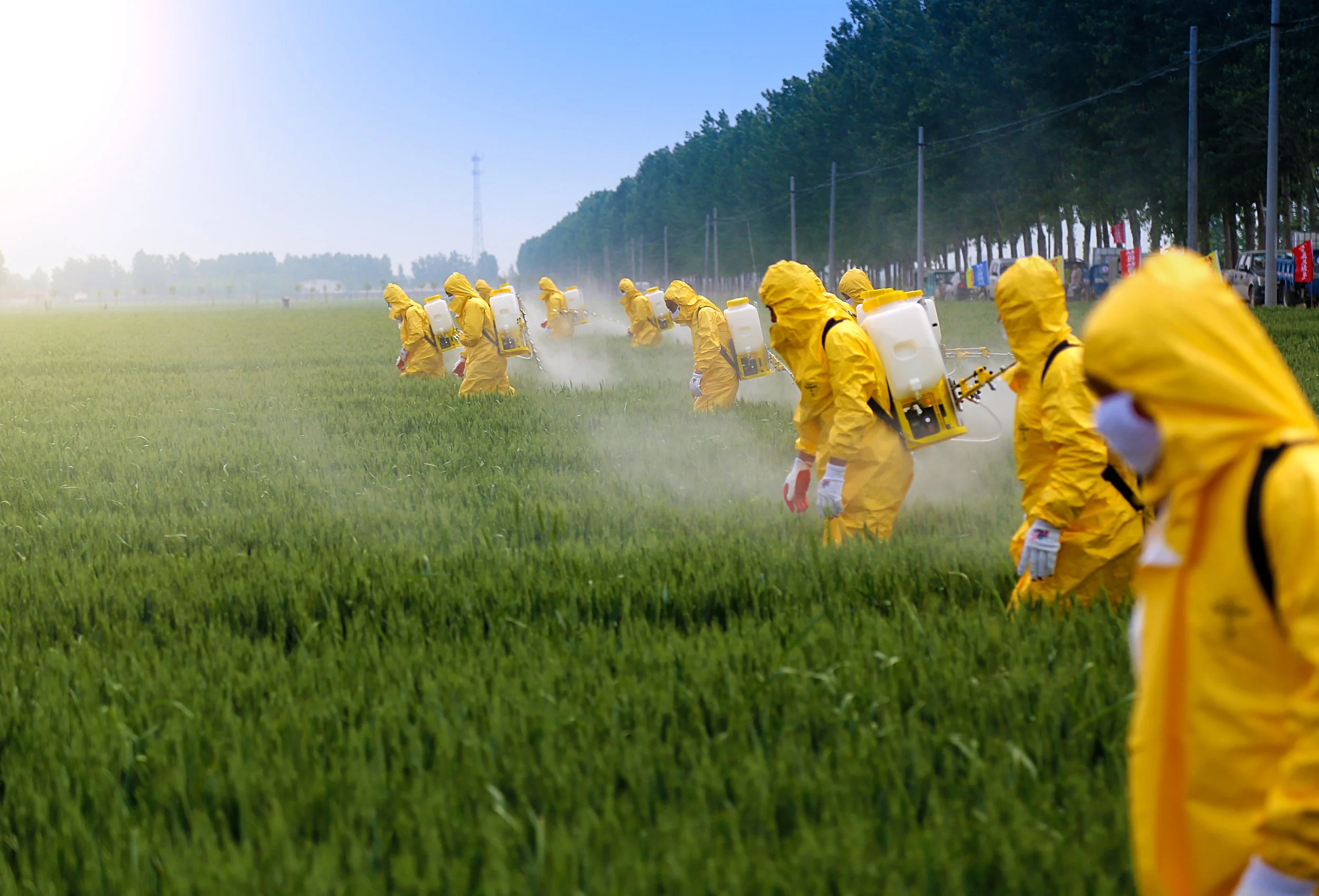
Roundup’s active chemical, glyphosate, interferes with a pathway crucial to the functioning of many plants and microorganisms.[4] It is directly applied to weeds, as you might expect, but it is also broadcasted indiscriminately to certain “Roundup Ready” crops such as corn, soybeans, and even cotton that have been genetically modified to tolerate it. Furthermore, it is used as a desiccant (a drying agent) in order to more efficiently time and execute wheat harvests.
While the consumer-grade formula for Roundup was changed as recently as 2022 under pressure of litigation, the commercial version deployed in agricultural operations continues using glyphosate. Bill Anderson, CEO of Bayer, can be seen doing media rounds in some attempt at damage control. Aside from vaguely addressing the cancer question and shifting blame to unscrupulous foreign influence in the “litigation industry,”[5] he at least attempts to highlight the finding that forgoing the use of the weed killer would reduce the yield of a range of crops between 20–40%.[6]
That’s no small effect. Whether or not it is overblown alarmism funded by agribusiness, supply chains are clearly reliant on the use of this particular kind of herbicide, and the consequences of a ban would surely reverberate beyond the domain of food logistics. The White House acknowledges this much and has deemed access to glyphosate a matter of “national security.”[7] Dangers of over dependence always lurk behind the introduction of new technology, and it is through the accumulation of such dependencies that the technological system increases its complexity, inter-connectedness, and points of failure which will, eventually, lead to a catastrophic collapse that will wipe out all complex life if it is left to reach its logical conclusion, unabated.
So, what health effects are humans left with in the meantime? The cancer risks are hard to ignore for those who work directly with the chemical in professional contexts, as billions of dollars continue to be doled out in settlements. But for those with a more distant and indirect relationship to the chemical, the picture becomes less clear. Establishing cause and effect in court becomes nearly impossible—not because the harm is absent, but because it is diffuse, spread across time, populations, and interacting variables. And yet it is precisely this kind of exposure that accumulates at the civilizational level, contributing incrementally to rising cancer rates in the industrial system.[8]
Also bear in mind that in addition to the currently known risks (in this case, cancer), we continually discover unexpected ways in which humans pay for their techno-integration. Advances in genetic sequencing have revealed just how important the gut microbiome is to physical and even mental health. Well, it turns out that the “shikimate pathway”—the one not present in the genome of mammals and the same one glyphosate disrupts—is used by some of the most crucial gut bacteria found in humans. While the levels of glyphosate in food are deemed acceptable in the US, these same levels adversely affect the gut microbiome.[9]
Glyphosate is the most heavily applied herbicide in the world.[10] Basically, everyone in the US has it in their body.[11] The fact that it doesn’t make them drop dead immediately is what keeps alternatives from being used because, right now, it offers the best yield on any investment in agricultural endeavors. And, glyphosate is only one herbicide. There are many other herbicides, insecticides, rodenticides, fungicides and storage agents with a diverse range of known health hazards that are avoiding public scrutiny. Alarming, but it is to be expected from the technological system.
Read Next


_________
NOTES:
[1] https://www.epa.gov/pesticides/epa-releases-draft-risk-assessments-glyphosate#:~:text=carcinogenic to humans
[2] https://www.iarc.who.int/featured-news/media-centre-iarc-news-glyphosate/#:~:text=probably carcinogenic
[3] https://www.pbs.org/newshour/nation/supreme-court-will-hear-appeal-by-maker-of-roundup-weedkiller-to-block-thousands-of-lawsuits
[4] Interestingly, a cursory search of glyphosate and this pathway will make sure to remind you that it is not a pathway that mammals share (more on this below).
[5] https://www.youtube.com/watch?v=JcFG08hPzaQ&t=2162s
[6] Oxford Economics; The Anderson Centre 2017. The impact of a glyphosate ban on the UK economy: a summary report. Crop Protection Association. p. 17
[7] From the White House:
“There is no direct one-for-one chemical alternative to glyphosate-based herbicides. Lack of access to glyphosate-based herbicides would critically jeopardize agricultural productivity, adding pressure to the domestic food system, and may result in a transition of cropland to other uses due to low productivity.”
[8] “Often a bad thing cannot be fixed because its specific cause is not known….it is believed that the rate of mortality due to cancer has increased by a factor of more than ten since the late 19th century, and that this is not a result merely of the aging of the population. This too is almost certainly in some way an outcome of the technoindustrial lifestyle, but, while some causes of cancer are known, the reason for the overall massive increase in the incidence of this disease is still a mystery.”
—Kaczynski, Theodore John, Technological Slavery, Vol. 1, Fitch & Madison Publishers, Scottsdale, AZ, 2022, p. 189
[9] Peter C. Lehman, Nicole Cady, Sudeep Ghimire, Shailesh K. Shahi, Rachel L. Shrode, Hans-Joachim Lehmler, Ashutosh K. Mangalam, “Low-dose glyphosate exposure alters gut microbiota composition and modulates gut homeostasis,” Environmental Toxicology and Pharmacology, Volume 100, 2023
[10] Benbrook, C.M., “Trends in glyphosate herbicide use in the United States and globally,” Environ Sci Eur 28, 3 (2016)
[11] Ospina, Maria et al. "Exposure to glyphosate in the United States: Data from the 2013–2014 National Health and Nutrition Examination Survey" vol. 170, 2022
Copyright © 2026 by Wilderness Front LLC. All Rights Reserved.
Newswire by The Heron