
Modern tech "saved" the ozone—so it could burn it up again
A case study in how technological progress inevitably violates nature
Article by qpooqpoo
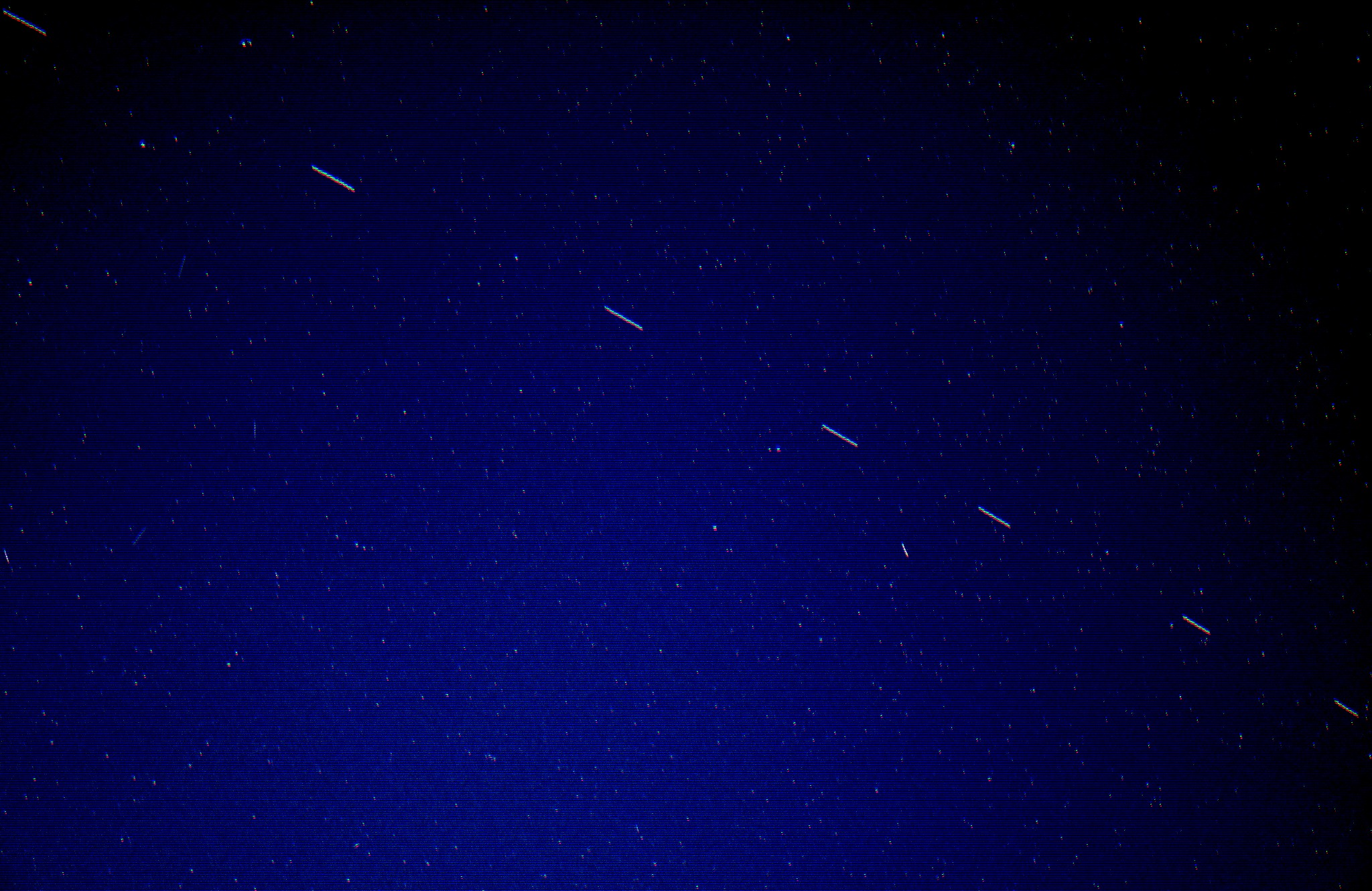
The ozone layer blocks 97% of harmful UV radiation,[1] shielding human health, ecosystems, and climate stability. Without a healthy ozone layer, the Sun’s UV radiation would sterilize the surface of the Earth. A recent study estimates that Starlink and similar satellite systems will increase ozone destroying aluminum oxide in the upper atmosphere by 640%[2]—not just rolling back all progress made in mitigating past damage from industrial chemicals, but making the damage even worse.
Since its announcement in 2015, media coverage of Starlink has been overwhelmingly optimistic. Even now, it's framed as a leap for humanity. The facts and figures were plain: thousands of low-Earth orbiting (LEO) mini-satellites would envelop the entire globe to provide high-speed internet access anywhere in the world.[3] The supposed benefits—connecting the most remote or impoverished areas of the globe—are endlessly repeated and rarely questioned. We know it's different: loss of privacy and tranquility, homogenization, propaganda, noise, and a life commodified and regulated, the dominance and control of large organizations at the expense of the individual. More blatantly, these networks are not just about browsing the web--they will be increasingly tied into global surveillance architecture, AI, military operations, and other forms of hard control. What's being built is not just a new commons, but an infrastructure of dependence and control.
Aluminum makes up a significant portion of the construction of current and projected LEO satellites, including Starlink's.[4] When the orbits of these satellites decay and they burn up in the atmosphere, the aluminum reacts with oxygen to form aluminum oxide. The aluminum oxide in turn acts as a catalyst to greatly speed up the ozone-depleting properties of both natural and man-made chlorine molecules in the atmosphere.[5] The Earth experiences a continuous stream of meteorites that disintegrate on atmospheric entry, but only a minute fraction of these natural bodies contain aluminum, and their entry speed and temperatures don't produce the same proportion of aluminum oxide. In a recent study published by Geophysical Research Papers, researchers at the University of Southern California accounted for the current projected deployment of mega-constellation systems (like Starlink) and extrapolated this chemical process to conclude that aluminum oxide could increase by 640% annually, amounting to 360 metric tons per year[6]—particles that may take up to 30 years to reach the stratosphere, where they begin destroying ozone.[7]
So much for all the techno-system's self-congratulatory affirmations on "healing" the ozone layer (after damaging it the first time around).[8] Unlike the CFC ban, which followed public outrage and a strong environmental movement, this threat has been met with silence. Likely the result of the growing fatalism and apathy in the public in the face of a technological juggernaut that seems to have far more weight and momentum than several decades ago. CFCs could be phased out because industrial nations had more than enough economic surplus to handle their removal and because economic alternatives to CFCs were found in time. There is no reason to believe that alternatives will be found, and found in time, for the satellite problem.
Perhaps the same system-wide performance could be achieved with geo-stationary satellites, which avoid the atmospheric drag that pulls LEO satellites down. But there must be significant economic and technical barriers to this alternative—otherwise these companies would not have invested so heavily in a long-term LEO infrastructure—and in any case, it would do nothing about the satellites already in orbit. Any solution must overcome the intense competitive pressures of self-propagating systems, where organizations that limit short-term gains for long-term concerns are outcompeted by those prioritizing immediate efficiency. In the cloud-based, colonial-style race for global internet users, it’s doubtful even a world-government mandate could enforce a shift toward long-term caution. As with every major technical advance, the entire world-system—including state and international bodies—is subject to the same pressure to maximize efficiency. Perhaps materials that do not cause ozone depletion and carry no major economic penalties could replace aluminum, but this remains a gamble, and even such materials could have unforeseen impacts.
The worst detail is the 30-year delay, an aspect almost perfectly designed to wreck the system. The world-system does not act on delayed consequences. It doesn't even act on present ones. Thirty-year-out threats are met with indifference, easily buried under distraction and propaganda.[9] By the time the evidence is undeniable, the damage will be beyond reversal. We’ve seen this pattern before: scientists have warned since the 1970s that plastic waste would accumulate in the environment, yet production has only increased. Now microplastics abound in every ocean, in the food chain, and in human blood—damage that cannot be undone.[10] The global reaction to the satellite problem will be just as slow and ineffective. This is not some fault of particular governments or ideology; it is a feature baked into the nature of the technological system. Self-prop systems prioritize short-term advantage against long-term hazards: governments and populations are gambling on speculative theory against short-term loss—even remote but clear existential threats such as the greenhouse gas problem, that of plastic waste, overfishing, or radioactive disposal rarely muster enough political will to effect the changes required in the present. Even if the system indefinitely halted the launch of all future LEO satellites now, there may already be enough satellites in orbit to cause significant damage.
[1]
This is a problem of the technology itself. Not its wise or unwise use. Its effects on the atmosphere are an inevitable outgrowth of its existence. The only thing that could be said to be a "misuse" would be for it to be used at all in the first place. But you can bet that will never happen so long as this technology confers to the world's self-propagating systems an advantage in their desperate competition for power and survival. These satellites do not exist in isolation. They are part of a desperate struggle for power—one that plays out between corporations, governments, and entire states, where self-propagating systems do not pause and ask whether they should continue—they pursue the path that offers short-term survival and strategic gain because they must prioritize short-term survival over long-term risk. The result is acceleration, where precaution is a liability and speed a necessity. No one wants to be left behind, and so they move forward regardless of the consequences. And the longer the satellite systems remain in place, the more they integrate into the industrial infrastructure as a whole, such that systems become so dependent on them that their elimination would entail unacceptable or catastrophic costs to the entire technological civilization. Systems don't stop because they should, they only stop when they can't go on.
Given the awesome scale of this threat, if we were living in a sane world—if "progress" were part of a rational program implemented willfully by humans to better the world as we're all told rather than an autonomous process that just has humans on a wild ride—one would expect a serious pause and sober reassessment of the whole project. One would expect daily coverage, investigations, debates, urgent international discussions. But the silence is almost total. Instead, the public is distracted—arguing over far less urgent debates—while an irreversible atmospheric crisis unfolds overhead. The fault lies in a media ecosystem designed to distract attention and redirect concern into carefully sanctioned, ideologically safe channels unthreatening to the core values and priorities of the technological system. In one especially revealing moment[3] on Scientific American's "Science Quickly" podcast, the host wedges vague concern between repeated praise for the "progress" made, reassuring the public while downplaying the looming crisis,[11] typical of the cognitive dissonance sustaining belief in progress despite mounting ecological damage.
Who has a say in the development of these distributed systems? Do you or I? So... we can vote on them? The world's self-prop systems who use them for power smother the public with propaganda and education in their favor, and command awesome financial and political resources and momentum. These systems are effectively imposed on the public. New tech is promoted as an unequivocal benefit, with downsides revealed only later. Technophiles present their ambitions and personal fulfillment as public service, while everyone else is left with the toxic consequences. Nothing in the record of modern technology suggests this will be different.
This article has focused on one specific threat—but others are no less urgent. Even if the environmental risk were zero, these satellite systems would still warrant firm rejection on social and moral grounds. And, ultimately, in spite of all the propaganda aimed to convince the public they want something predetermined by material forces anyway—the long-term consequences of this technology, and how it expands and interacts with other technologies and the complex web of human society and the biosphere are entirely unknown.
Read Next

___________
NOTES:
[1] Ritchie, Hannah, "What is the ozone layer, and why is it important?" Our World in Data, March 13, 20203. Last accessed on Apr. 8, 2025 at: https://ourworldindata.org/ozone-layer-context#:~:text=The%20ozone%20layer%20absorbs%2097,can%20damage%20and%20disrupt%20DNA.
[2]Ferreira, J. P., Huang, Z., Nomura, K.‐i., & Wang, J. (2024). Potential ozone depletion from satellite demise during atmospheric reentry in the era of mega‐constellations. Geophysical Research Letters, 51, e2024GL109280.
[3] By bypassing ground-based infrastructure, such as fiberoptic cable networks and cell towers, the Starlink network can rely on phased-array antennas and laser interlinks to send and receive internet signal from anywhere in the world. There's still the need for ground antennas to connect to the Starlink network and send and receive internet data, but these are relatively small—about 2 feet in diameter—and are expected to miniaturize further as the network of satellites expands and the reception technology improves.
[4] Ferreira, et al., 2024, "[M]ost structural elements made of aluminum alloys... We assume 30% of the total mass of the satellite to be made of aluminum." These figures are based on a reasonably hard date: see, e.g., Bonvoisin, B., Meisnar, M., Merrifield, J., Beck, J., Lips, T., Gülhan, A., et al. (2023). Demisability assessment of space materials. CEAS Space Journal, 15, 213–235.
[5] Ibid., "[Aluminum oxides] are known catalysts for chlorine activation that depletes ozone in the stratosphere."
[6] Ferreira, et. al. (2024), "Looking into the future by applying reentry forecasts considering the deployment of mega constellations, the aluminum excess ratio at the top of the mesosphere can reach an yearly excess of more than 640% above natural levels, or over 360 metric tons of aluminum oxide clusters per year from satellites..."
[7] Ibid., “[T]hese reentry byproducts may take up to 30 years to settle from the top of the mesosphere into the stratospheric ozone layer. …introduce a noticeable delay between the beginning of the injection process when orbiting bodies are decommissioned and the eventual ozone depletion consequences in the stratosphere.”
[8] This is not an overstatement; the public is still being reassured by the media that progress has been made since the Montreal Protocol banned ozone-depleting chemicals in the late 1980s. In a particularly detached example: "The Earth's ozone layer is on its way to recovering, thanks to decades of work to get rid of ozone... The impact the Montreal Protocol has had on climate change mitigation cannot be overstressed." From: Jacyln Diaz, "The ozone layer is on track to recover in the coming decades, the United Nations says," NPR, Jan. 10, 2023.
[9] No doubt a testament to the techno-industrial system's far more advanced capacities for mounding public attitudes—a triumph of its techniques of social control.
[10] The scientist Edward J. Carpenter first published warnings about what would become known as "microplastics" in two 1972 papers. Edward J. Carpenter, K. L. Smith, Jr., "Plastics on the Sargasso Sea Surface," Science 175, 1240-1241 (1972); Edward J. Carpenter et al., “Polystyrene Spherules in Coastal Waters,” Science 178, 749-750 (1972). Several similar papers followed in the ensuing decade.
[11] "In other words, if we want to maintain the amazing progress we've made in healing our ozone layer, which again, huge progress, we should absolutely be patting ourselves on the back for that. We need to also pay attention to what we're putting up into space." Rachel Feltman, Kelso Harper & Fonda Mwangi, "There’s No Need to Panic over ‘Flying’ Spiders, and Satellites Are Not So Great for the Ozone Layer," Science Quickly, podcast audio and transcript, Scientific American, June 17, 2024. The "not so great" part says it all.
Copyright © 2026 by Wilderness Front LLC. All Rights Reserved.
Article by Potash